

















Insecurity, lack of grazing routes push herders to Cameroon, Chad
Source Daily Trust Our Reporters
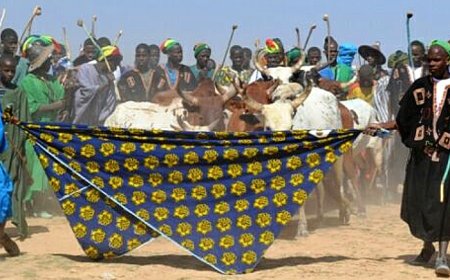
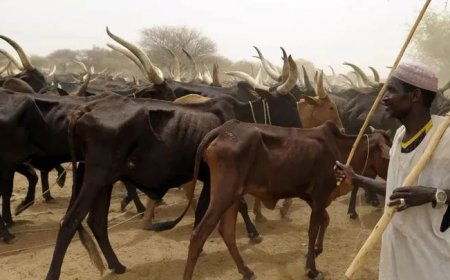
A silent economic crisis is unfolding along Nigeria’s borders as millions of livestock are being moved into neighbouring countries. As a result, there’s a mass migration of Fulani herders to Cameroon, Chad, Niger and Central African nations.
The migration, according to the herders, was necessitated by persistent insecurity, occasioned by Boko Haram insurgency, banditry and cattle rustling, coupled with lack of commitment on the part of the Nigerian government to protect them and their livestock.
For decades, livestock farming has been the cornerstone of Nigeria’s agricultural economy, but the current situation has forced thousands of pastoralist families to abandon the country in search of more stable environments.
Weekend Trust toured border communities in Adamawa, Taraba, Yobe and Borno states to report firsthand accounts of how pastoralists massively move their herds across the border.
With a deep sense of disappointment, many of the pastoralists said the landscape where traditional grazing routes existed had been overtaken by expanding farmlands, and there are no state-provided alternatives, such as ranches.
“In some forests, we spent over a century breeding our livestock, but the states banned open grazing without putting any alternative in place.
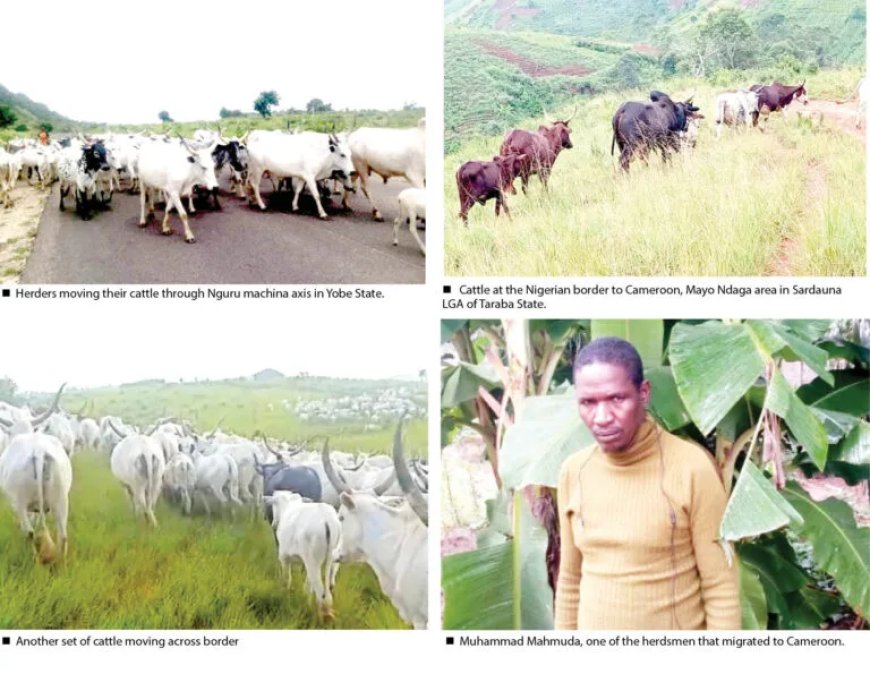
“Our routes have been converted to farmlands and movement has become impossible,” said Mahmuda Muhammad, a herder who recently relocated with over 1,000 cattle to Cameroon.
Muhammad explained that security and fodder influenced herders to stay in Cameroon despite spending money on entry permit, tax, documentation and annual rate for cattle tax per herd.
For Fulani herders like Abubakar Yolar Margami, who is moving his herd towards Ngabuji reserve in Niger Republic, the decision is one of survival.
“The situation in Nigeria is so bad that a herder with more than 20 cattle cannot find a meadow to graze,” he explained.
Margami, who was within Machina, a border local council in Niger Republic from Yobe State, noted that they were crossing into Niger where they believed they would have freedom.
“Farmers have taken over all our routes. The government knows this but not doing anything,” he alleged.
He said it was fear and constant threat of cattle rustlers, kidnappers and perennial clashes with farmers that forced them to migrate.
Arduous journey to freedom
Weekend Trust reports that Fulani herdsmen migrate hundreds of kilometres from Enugu, Delta, Benue and various parts of the South-West to border towns, including Mayo Ndaga in Sardauna Local Government Area of Taraba State, seeking a new life that is free from tension.
Our correspondent who went to the area reports that the journey across the Mambilla plateau is perilous. It was noted that herdsmen, along with their families, in their quest for survival and safety, endured heavy rainfall and rugged terrain to move to neighbouring countries for safety.
According to local sources, many of the women and children who often perch atop donkeys always appear visibly exhausted and suffering from poor health.
Musa Adamu, a local bureau de change operator in Mayo Ndaga, who has witnessed such scenarios firsthand, said that residents always trooped out in large numbers to watch the movement in amazement.
“I changed millions of naira to the Cameroon currency for these families as they prepared to exit the country,” he said.
Speaking on their experiences during the movement, one of the herders who simply gave his name as Betti, said they were required to pay various taxes to Sardauna Local Government and border officials at the Kan Iyaka checkpoint.
“Where we don’t have money, we often sell portions of our livestock to cover these costs,” he said.
Alhaji Adamu Saidu, a Fulani leader in the region, told Weekend Trust that their migration was not a spontaneous decision but a long-planned departure in search of peace.
Describing how herdsmen from the South-East, South-West, Benue and Nasarawa were forced to move, he said, “Fellow herdsmen told me that they were forced to relocate because of intense pressure from host communities. They reported that their children were being killed and their animals rustled by hostile youths, who often profile every herdsman as a criminal,” adding that representatives of the herdsmen had previously travelled to the Central African Republic and Cameroon to secure grazing rights. He noted that authorities in the Central African Republic had designated a massive tract of land at the border as a dedicated grazing reserve for the arriving groups.
Weekend Trust, however, reports that the scale of the migration has created local friction in Mayo Ndaga, where farmers have lodged complaints that the millions of cattle passing through the community had destroyed their crops.
One of the farmers said: “As a result, other groups of migrants are expected to bypass Sardauna Local Government, opting instead for an international cattle route through Gashaka Local Government Area, leading directly to the Kan Iyaka border post.”
Nigeria losing revenue to neighbours
As the herders cross the borders, they contribute significantly to the revenue of neighbouring countries through entry permit taxes, documentation fees and annual grazing levies.
Narrating the strict procedure they followed before accessing Cameroon, Mahmud Muhammad revealed that his family alone paid over N2 million in border taxes.
“I watched over one million cattle crossing into Cameroon. It is heartbreaking to see Nigerian resources migrating to neighbouring territories.
“Nigerian authorities are losing millions in potential revenue, the financial implications are staggering,” he said.
He explained that apart from the entry permit tax and documentation, they also had to pay an annual rate for cattle tax per herd when they arrived at the meadow to graze, a CFA amount equivalent to N20,000.
“I paid tax for the four herds my family took into the country. I made this year’s payment six months ago to avoid a penalty,” he said.
Conversely, Muhammad said the Cameroonian government implemented a structured system that tracks the movement of herds via a comprehensive database.
“This provides us with security, lush grazing areas, and in return, their government receives consistent tax revenue, unlike the volatile and unprotected environment we left behind,” he said.
According to Muhammad, when they were in Nigeria, many of them were subjected to extortion by thugs and even some security operatives.
He also said, “As peaceful herders, we felt we no longer had a place in Nigeria. We were losing our wealth to criminals and were denied access to water points. How can cattle survive without food and water?”
He added that it’s heartbreaking to see Nigerian businessmen who are into hides and skin trade relying on Cameroon, Sudan and Central Africa for the products.
“These are hides and skin they are supposed to buy from us at their doorsteps in Nigeria before things degenerated,” he said.
Int’l dealer speaks
An international hides and skin dealer, Muhammad Mele, told our correspondent that the impact of pastoralists’ migration was felt across the supply chain in Nigeria. He recalled that when cattle herders were operating peacefully in Nigeria, a larger part of the hides and skin were being sourced in Maiduguri and other parts of the country.
“We once sourced 50 per cent of their products within Nigeria, but since the livestock sector started facing crisis, we have been relying on imported goods from Sudan and Central Africa. Surprisingly, it is where Nigerian herders settled,” he noted.
Sadly, these hides and skin dealers now cross to Cameroon, Chad and up to Central Africa to transport the products back to Nigeria.
A serious country will not be silent – Analyst
A public affairs expert, Alhaji Ahmadu Ibrahim, who is also the Head of the Department of Sociology, Yobe State University, Damaturu, wondered why the federal government remained silent on the livestock migration out of Nigeria.
He said that as a country, Nigeria should be worried over the significant volume of its livestock industry and the associated tax revenues that depart to neighbouring countries.
“With sound policies and effective implementation, the government will recover the past glory of our livestock production and improve on it. It will provide jobs and protein for the country,” he said.
Local leaders of pastoralists across Yobe, Borno, Adamawa, Taraba who spoke with Weekend Trust lamented over the spate of insecurity and bad policies that affect the survival of cattle herders in Nigeria.
The Yobe State chairman of the Miyetti Allah Cattle Breeders Association of Nigeria (MACBAN), Alhaji Ibrahim Nangere, corroborated the above claims, pointing to encroachment on cattle routes, even in states where they have been officially gazetted, as a primary failure of the state to protect the livestock sector.
Adamawa
The Adamawa State chairman of the Kautal Pula’aku Fulbe Association of Nigeria, Abubakar Usman Yir-labe, said the exodus of the nomadic Fulani to neighbouring Cameroon Republic was due to the unfriendly environment in Nigeria.
According to him, in Cameroon they have access to feed; and the government provides enough security for them, contrary to what is happening in Nigeria.
He explained that lack of demarcated grazing reserves was the major problem the Nigerian government failed to address.
“Also, the level of hatred against herders, especially now that bad elements amongst us are into kidnapping, is alarming. People don’t trust us,” he alleged.
Yir-labe noted that some of the nomadic Fulani had already moved out of the country through borders in the state, such as Gurin in Fufore Local Government Area, as well as Maiha and Toungo borders in the south.
He said the migrating herders informed union officials that the Fulani traditional leaders charged them in cash or kind, like using a bull or sheep, depending on the capacity of the nomad.
“Our people told us that they paid certain tokens in cash or kind, like giving out a cow, bull or even a sheep, depending on the capacity and circumstances. But in all honesty, they always welcome our people within open hands and love,” Yir-labe said.
On the contrary, however, Alhaji Ja’oji Isah, the chairman of the Miyetti Allah Cattle Breeders Association, Adamawa State branch, said Fulani nomads were only crossing to Cameroon to graze and come back, which he added had been a periodic culture for them.
Isah explained that the nomadic Fulani in the sate were known for moving their animals in search of feed within and outside the country, adding that only few opted to relocate permanently due personal reasons.
He said that on average, a total of 85 per cent of nomadic Fulani from Adamawa moved around the borders to graze their animals, especially around Cameroon. He called on the state and the federal government to establish a scheme where the nomadic Fulani would be taught the modern way of animal rearing and farming, with a view to keeping them in one place.
“We are calling on the government to create a scheme where our people will be taught on the best modern techniques for farming and rearing of cattle in the best interest of all.
“Yes; our members are known with movement from one location to another in search of feed for their animals; hence even if they move to Cameroon, they go and come because there are multiple of grazing reserves over there, not like ours here in Nigeria and Adamawa in particular.
“On the part of our people, we are urging them to remain in Nigeria and graze their animals, which is cheaper despite the little security challenges, which the government is doing its best to tackle,” Ja’oji Isah said.
Asked what it would take for the displaced herders to return, the answer remained consistent: justice for farmers and pastoralists, protection of gazetted routes, and meaningful government’s intervention.
Contributions from Hamisu Kabir Matazu (Maiduguri), Magaji Isa Hunkuyi (Taraba) & Umar Dankano (Yola)